
Table of Contents
What Is Hyaluronic Acid?
Hyaluronic acid is found deeply implanted in human tissues because it is produced by a human in a continuing process. It is found in every human body tissue such as skin, eyes, jaw, joints, connective tissues, cartilage, etc. It has the vital function of moisture and tissue repair maintenance.
Almost 50% of the total hyaluronic acid found in the human body is preserved in the skin, and the skin needs to be maintained and externally preserved because it is responsible for skin hydration, elasticity, and a youthful look.
It is a body-made substance found in numerous cells of the body in bones, joints, eyes, and gums. Almost 50% of the body’s total hyaluronic acid is found in the skin
Medical Uses of Hyaluronic Acid by Field
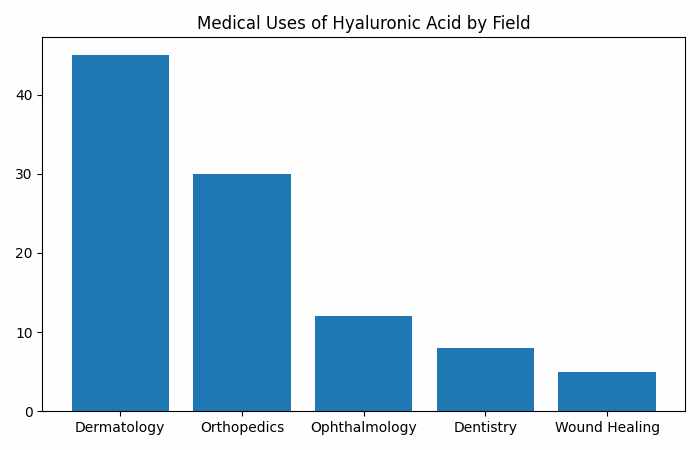
| Medical Field | Usage (%) |
| Dermatology & Aesthetics | 45 |
| Orthopedics | 30 |
| Ophthalmology | 12 |
| Dentistry | 8 |
| Wound Healing | 5 |
Aesthetic medicine has successfully used the properties of it in different regenerative and trauma treatments and therapies. This article will show its applications and benefits.
In the joints, it is found in the synovial fluid of the intra-articular cavities and gives them viscosity. Therefore, it is a powerful ally in the prevention of joint damage.
Where Is Hyaluronic Acid Found in the Human Body?
Hyaluronic acid is found in every human tissue and organ in the body, and its function can be described to depend on its location. Its presence is referred to as a sign of the body part needing flexibility, hydration, and shock absorption.
Natural Distribution of Hyaluronic Acid in the Human Body
| Body Tissue | Approximate Presence | Main Function |
| Skin (Dermis) | ~50% | Hydration, elasticity, wrinkle prevention |
| Synovial Fluid (Joints) | High | Lubrication, joint protection |
| Cartilage | Moderate | Shock absorption, flexibility |
| Eyes | Moderate | Moisture retention, eye comfort |
| Connective Tissue | Present | Structural support |
| Gums & Oral Tissue | Present | Healing and inflammation control |
Functions of Hyaluronic Acid in the Human Body
Hyaluronic acid is generate inside the body and is responsible for essential functions, including:
The conservation of the hydration levels of the dermis provides an essential regenerative effect on the skin, given its ability to accumulate water. Therefore, the use of products comprising this active ingredient gives volume to the skin and reduces the appearance of wrinkles.
- They plays an essential role in the epidermis. It serves to enhance the elasticity of the skin. It improves the hydration of the epidermis tissues and helps the formation of cartilage. Drives and accelerates the synthesis process carried out by the ribosomes of the cells to generate collagen.
- Is part of the synovial fluid that surrounds the joints.
- It is present in the tendons and ligaments. These structures that connect the muscle with the bone are made up of connective tissue where it is found, giving them elasticity during movement.
Natural Decline of Hyaluronic Acid With Age
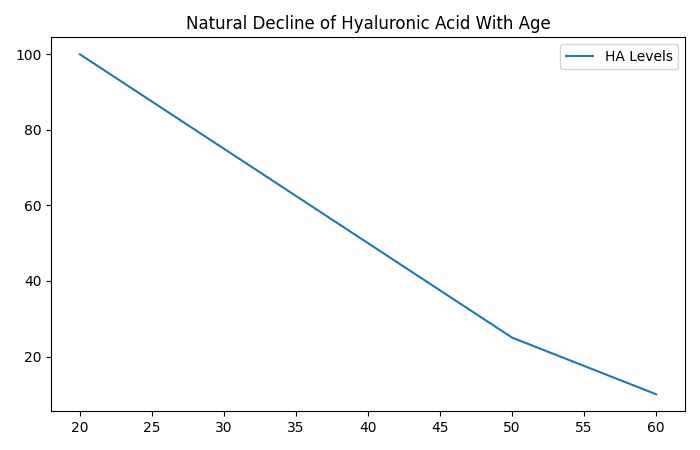
| Age (Years) | HA Levels (%) |
| 20 | 100 |
| 30 | 75 |
| 40 | 50 |
| 50 | 25 |
| 60+ | 10 |
Scientifically Proven Properties of Hyaluronic Acid
It has numerous studies documenting its molecular characteristics and interactions in fields like dermatology, and regenerative medicine. Some of such studies and their documented attributes include:
- Hygroscopic ability: as a natural humectant, It can absorb and hold more than a thousand times its weight in water.
- Barrier repair: It fortifies the skin’s extracellular matrix, and structural integrity.
- Anti-inflammatory effects: It has useful effects in decreasing inflammation in the joints, skin and connective tissues.
- Cell signaling: It helps in wound healing by directing the movement of cells to injured sites and help in tissue repair.
- Lubrication: as a it is a biological lubricant in joints and connective tissues, it reduces friction and wear.
These benefits illustrate the combination of it in the formulation of numerous products in the orthopedics, ophthalmology, cosmetics, dentistry, and aesthetic medicine fields.
Types of Hyaluronic Acid Used in Skincare & Medicine
All hyaluronic acid will not works the same. Its efficiency depends on molecular weight, which determines how deeply it penetrates.
| Type of Hyaluronic Acid | Molecular Size | Primary Benefit | Where It Works Best |
| High Molecular Weight HA | Large molecules | Surface hydration, protective film | Dry, sensitive skin |
| Low Molecular Weight HA | Smaller molecules | It help deep hydration, elasticity | Aging & dehydrated skin |
| Hydrolyzed Hyaluronic Acid | Very small | Helps Penetrates deeper layers | Fine lines & texture |
| Cross-linked Hyaluronic Acid | Stabilized form | Benefits Long-lasting volume | Dermal fillers & joint therapy |
It clarifies why multi-weight it formulations are considered more effective for skincare and medical use.
How Hyaluronic Acid Benefits Different Age Groups
| Age Group | Role of Hyaluronic Acid | Visible Benefits |
| 20s | Maintains hydration & elasticity | Plump, healthy skin |
| 30s | Slows early aging signs | Reduced fine lines |
| 40s | Restores volume & firmness | Improved skin density |
| 50+ | Compensates for HA loss | Reduced sagging & dryness |
Primary Reasons People Use Hyaluronic Acid
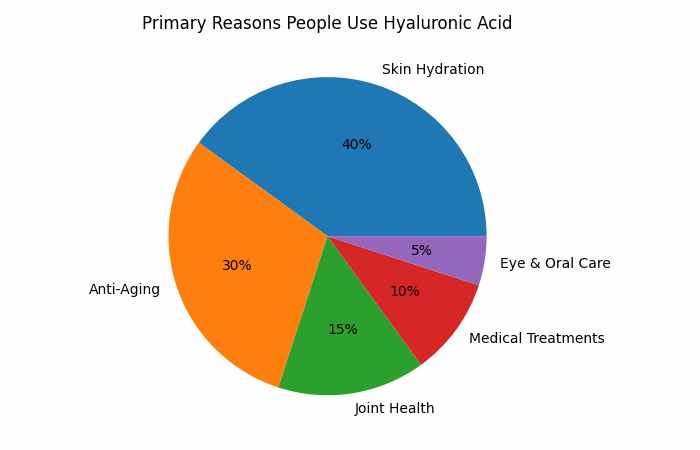
| Purpose | Percentage |
| Skin Hydration | 40% |
| Anti-Aging | 30% |
| Joint Health | 15% |
| Medical Treatments | 10% |
| Eye & Oral Care | 5% |
Dietary & Lifestyle Factors That Support Natural Hyaluronic Acid Levels
To improve internal production naturally:
Diet and Lifestyle Factors that Encourage Natural Production of Hyaluronic Acid To boost your body’s production of natural hyaluronic acid:
Maintain hydration (water influences the function of HA) Incorporate magnesium, zinc, and vitamin C rich foods Include soy, citrus fruits, leafy greens and bone broth Limit your exposure to UV radiation
What Causes A Lack Of Hyaluronic Acid?
The aesthetic doctor “Every day, the human body degrades and re-synthesizes approximately a third of all the hyaluronic acid it contains and, in addition, it is destroy after 20-25 years”.
At 40 years of age, it reserves exceed 50%, but after 60, only 10% of them remain. The causes of this are due to a mixture of internal and external factors: genetic, environmental, and the adopted lifestyle.
Genetic factors. In adolescence, the estrogen level is high, the face contour is well define, and the skin is smooth and elastic. However, hormone levels and the number of cells that give volume to the skin decrease over the years, The arrival of menopause accelerates this.
Environmental factors. Continued exposure to sunlight causes the progressive degradation of hyaluronic acid and collagen in the skin.
The lifestyle: Carrying a healthy lifestyle and eating habits affects the state of the skin. In addition, the ingesting of nicotine and other tobacco chemicals reductions the properties of it.
What Symptoms Does a Lack of Hyaluronic Acid Produce?
Certain factors such as tobacco, solar radiation,or lack of sleep, increase the production of free radicals. These, in turn, affect the decrease in it and also slow down its production. The damage that this cause does not take long. to become visible. Among the evident symptoms are:
- Loss of flexibility and inflexibility of the skin.
- The appearance of wrinkles.
- Skin dehydration.
- Tightness, thinning and loss of density in the skin
Benefits Of Hyaluronic Acid
Both in aesthetics and medicine, many benefits are obtain from applying it. These include the following:
- Maintains good skin hydration; it can hydrate even its deepest layers, helping to maintain its thickness, volume and smoothness. Therefore, it is use to prevent or delay the appearance of wrinkles.
- Useful in the treatment of degenerative diseases of the joints. In conditions such as osteoarthritis, it is increasingly common to perform infiltrations of this substance to reduce pain and regenerate cartilage. Scientific studies have shown its efficiency in relieving the symptoms of osteoarthritis.
- It improves healing and regenerates the gums and the oral mucosa. It is also use in the surgical treatment of temporomandibular joint dysfunction.
Hyaluronic Acid Moisturizer – Why It’s a Skincare Essential
It is the best and effective ways to keep skin plump hydrated and healthy. It can attract and hold large amounts of water, moisturizers formulated with this ingredient support prevent moisture loss while improving skin texture and elasticity.
Unlike heavy creams, this moisturizers work well for all skin types, including oily, acne-prone, and sensitive skin.
Key Benefits
- Fit for morning and night skincare routines
- It Provides long-lasting hydration without a greasy feel
- Soothes dryness, tightness, and irritation
- Benefits smooth fine lines caused by dehydration
- Strengthens the skin barrier and recovers elasticity
Top Hyaluronic Acid Brands & Serums by Country
| Country | Brand & Product | Price (Approx.) | Why It’s Popular |
| India | The Ordinary Hyaluronic Acid 2% + B5 | ₹1,000 | Budget-friendly, multi-molecular HA hydration |
| Suganda Hyaluronic Acid Serum | ₹599 | Gentle, affordable Indian option | |
| COSRX Hyaluronic Acid 3 Serum | ₹1,541 | Lightweight Korean formula with deep hydration | |
| USA | CeraVe Hyaluronic Acid Serum | $18–$22 | Dermatologist-recommended, barrier-supporting |
| The Inkey List Hyaluronic Acid | $8–$12 | Simple, effective daily hydration | |
| SkinCeuticals H.A. Intensifier | $120+ | Premium anti-aging hydration booster | |
| UK | The Ordinary Hyaluronic Acid 2% + B5 | £6–£9 | Best-value HA serum |
| Medik8 Hydr8 B5 Intense | £59 | High-end hydration with vitamin B5 | |
| South Korea | Torriden DIVE-IN HA Serum | ₩20,000–₩30,000 | Multi-HA, fast-absorbing, highly rated |
| Innisfree Green Tea Seed HA Serum | ₩30,000–₩40,000 | Hydration + antioxidants | |
| France | Vichy Minéral 89 | €30–€40 | Pharmacy favorite for daily hydration |
| La Roche-Posay Hyalu B5 | €25–€40 | Dermatologist-trusted anti-aging serum |
How a Hyaluronic Acid Moisturizer Works for Different Skin Types
| Skin Type | Benefits of Hyaluronic Acid Moisturizer |
| Dry Skin | It deeply hydrates and reduces flakiness |
| Oily Skin | Helps hydrates without adding oil or clogging pores |
| Sensitive Skin | It calms irritation and supports barrier repair |
| Aging Skin | It help improves plumpness and softens fine lines |
| Combination Skin | Helps in balancing hydration across dry and oily areas |
How to Use a Hyaluronic Acid Moisturizer for Best Results
The moisturizer should be applied on damp skin for maximum efficiency. This allows the product to work at its best to trap in moisture. During the day, a moisturizer should be followed with sunscreen to protect the skin from losing moisture and to shield from environmental damage.
Uses Of Hyaluronic Acid
Many of the beautifying products on the market contain obtained by synthesis, which manages to penetrate the skin, mix with natural and promote the production of this substance and the formation of collagen. Among the forms of presentation of this substance are:
Blisters
They have repaired and restructured action with an anti-wrinkle effect since they increase elasticity and cell metabolism.
Eye Contour Gel
These gels typically contain retinol, collagen, and it and offer intense hydration and wrinkle reduction.
Night Cream
They are base on collagen and are use to treat the signs of ageing.
Conclusion
It can attract and retain water, keeping these tissues in good condition. However, in the ageing process, it slowly begins to decrease, and as a result, the skin becomes saggy, loses its firmness and elasticity, and the feared wrinkles appear.
